
How do payment remittance notifications work?
This article explains what payment remittances are, how they work, and what they look like in ExpensePlus. It also answers some frequently asked questions about remittance notifications.
In this article:
- What is a payment remittance?
- An example payment remittance
- How do payment remittances work in ExpensePlus?
- Frequently asked questions (FAQs)
- Why do some payments have my church / charity name as the reference?
- Can I customise the payment reference?
- Do I need to include my church / charity name in the payment reference?
What is a payment remittance?
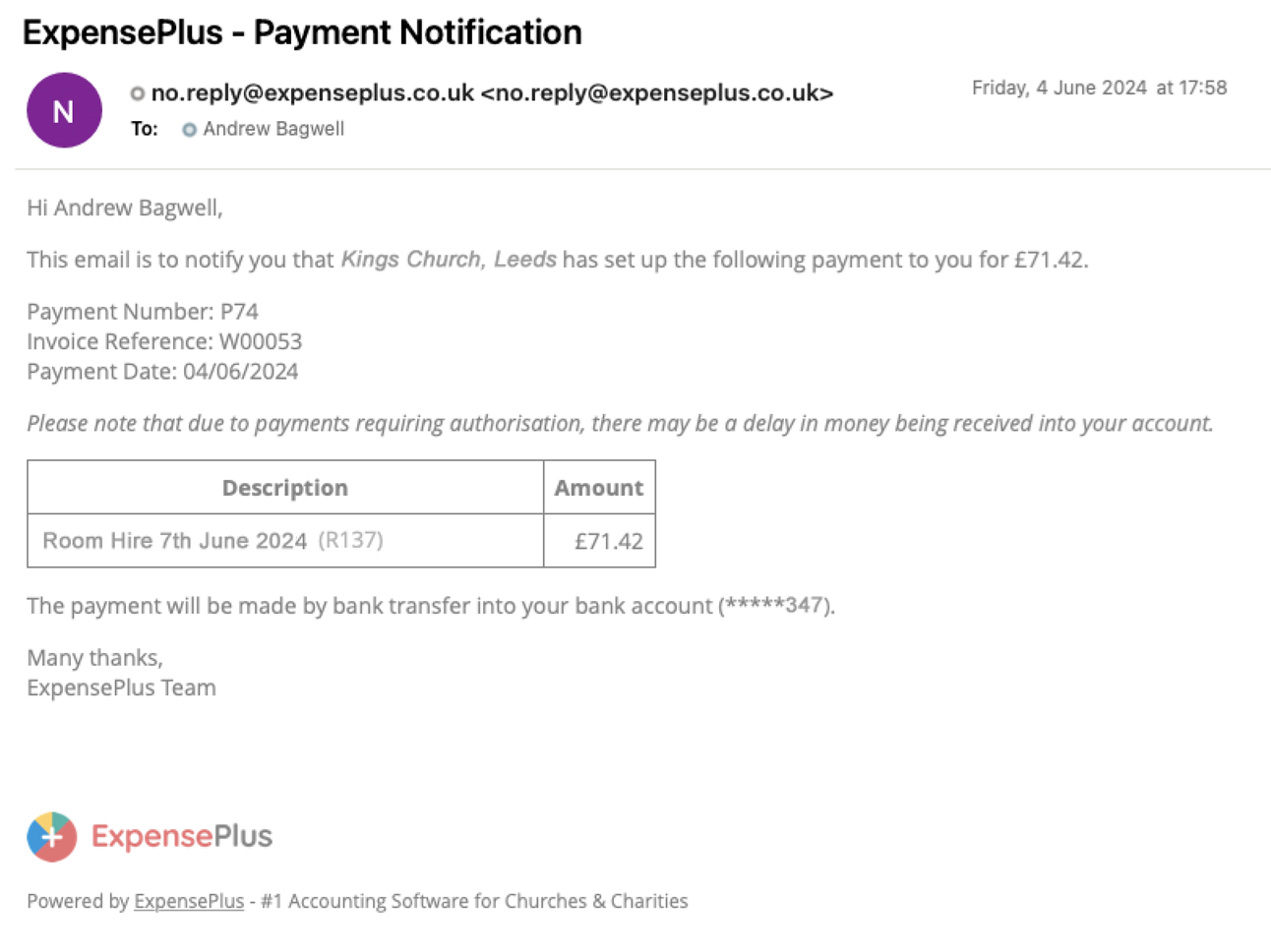
Remittance emails (also called 'payment notifications') are automatically generated and sent to the supplier or payee when you confirm that a payment has been made by bank transfer on the Payments Screen within ExpensePlus.
The remittance email includes:
- details of the payment;
- the last 3 digits of the bank account into which the payment was made;
- for invoice payments, the invoice reference number is included if this was specified when the invoice was entered in ExpensePlus.
An example payment remittance
An example of a remittance email is shown below.
How do payment remittances work in ExpensePlus?
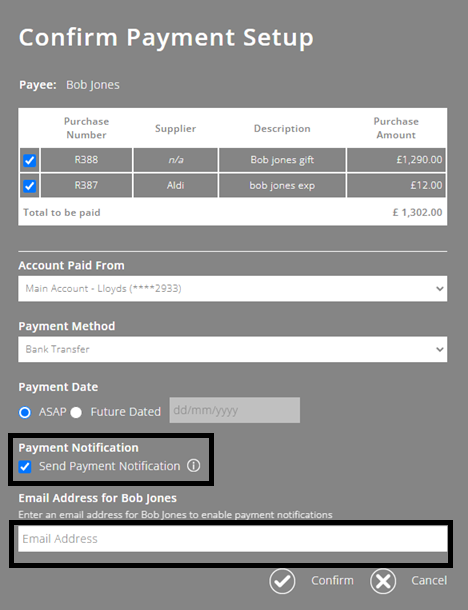
In order for you to send a remittance notification email, the Supplier/Payee must have an email address set up in ExpensePlus. If an email address hasn't been added, then the person setting up the payment can add it at the bottom of the 'Confirm Payment Setup' pop-up.
The payment notification email is based on a template and can't be amended. However, you can choose not to send a remittance email by unticking the 'send payment notification' box in the 'Confirm Payment Setup' pop-up.
Frequently Asked Questions (FAQs)
Why do some payments have my church / charity name as the reference?
When a supplier sends you an invoice to pay, they typically include an invoice number or reference that they want you to quote when paying the invoice. For this reason, where an invoice number or invoice reference has been entered for an invoice, ExpensePlus automatically uses this as the payment reference (rather than generating a unique payment reference, such as P1234).
If no invoice reference has been entered, ExpensePlus will use your church / charity name instead as the payment reference. However, it's better that you update the purchase and add in the missing invoice reference.
Can I customise the payment reference?
Currently, it's not possible to customise a payment reference within ExpensePlus (except for invoice payments, where the payment reference is based on the invoice number that has been entered).
We also recommend that you don't change the payment reference, for two reasons. First, the automatically generated payment reference (e.g. P1234) is unique, and allows an easy way to identify payments within ExpensePlus. Second, the payment reference is automatically included in payment notification emails so the person or organisation being paid can easily identify the payment and what it relates to, which in turn reduces payment queries.
Do I need to include my church / charity name in the payment reference?
There is no need to include your church or charity name in the payment reference field. Your organisation name will typically show up automatically in the bank statement description of the person / company / organisation you are paying.
The bank description combines [Account Name] + [Payment reference]. For example, if your organisation name is 'Kings Hope Church' and you enter the payment reference as 'P1234', this will show up on the recipient's bank statement as 'Kings Hope Church P1234'. So it already includes your organisation name in the payment reference.
If you try to add your organisation name in the reference field, this could result in a long payment description. In this case, the unique payment reference (which is the key detail payees will find helpful to identify payments) could get cut off, meaning it wouldn't then appear on the recipient's bank statement description.
To help you better understand the Payments module as a whole, please visit the module overview page here.