
Expenditure Category Transfers
This article explains why you might want to make an expenditure category transfer, and how to create the transfer within ExpensePlus.
In this article:
Uses of Expenditure Category Transfers
- Your charity or church may have decided to allocate or 'ring-fence' a specified portion of your expenditure each month for a specified purpose.
- For example, 10% of your expenditure budget is to be covered by your building fund, or perhaps your reserves fund. Or you might have a project or event that sits inside a separate fund that you have agreed to subsidise with money from another fund.
- These are examples of when you need to cross-charge expenditure.
Where any of these are the case, you can use the 'transfer between categories' feature within the Adjustments Screen. This will allow you to record the transfer out of your general fund, and into the appropriate category of the designated (or restricted) fund.
It's not possible to record this as an expenditure transfer out of one fund, and into the other fund as income, as this would result in your annual income and expenditure both being over-inflated in your end-of-year accounts
Splitting a transaction across multiple funds or categories
As an alternative method of cross-charging expenditure, rather than adding a transfer between expenditure categories, it may be simpler to split a transaction across multiple funds or categories.
In the example below, a single expense transaction has been split across multiple categories and funds, dividing up a wholesale catering invoice for 3 different purposes.

Even if this split is not completed at the point of purchase, you can retrospectively edit the transaction (from the Purchases screen) to create the 'split', as long as the total purchase value (across all funds/categories) still matches the total that was originally entered.
Cross-charging through the Adjustments module
Alternatively, you can use the Adjustments module to apportion income or expenditure from one category to one or more others. The example below illustrates how to achieve the same split as the above 'cross-charge', using the Expenditure Category Transfers button.
To create an expenditure category transfer:
-
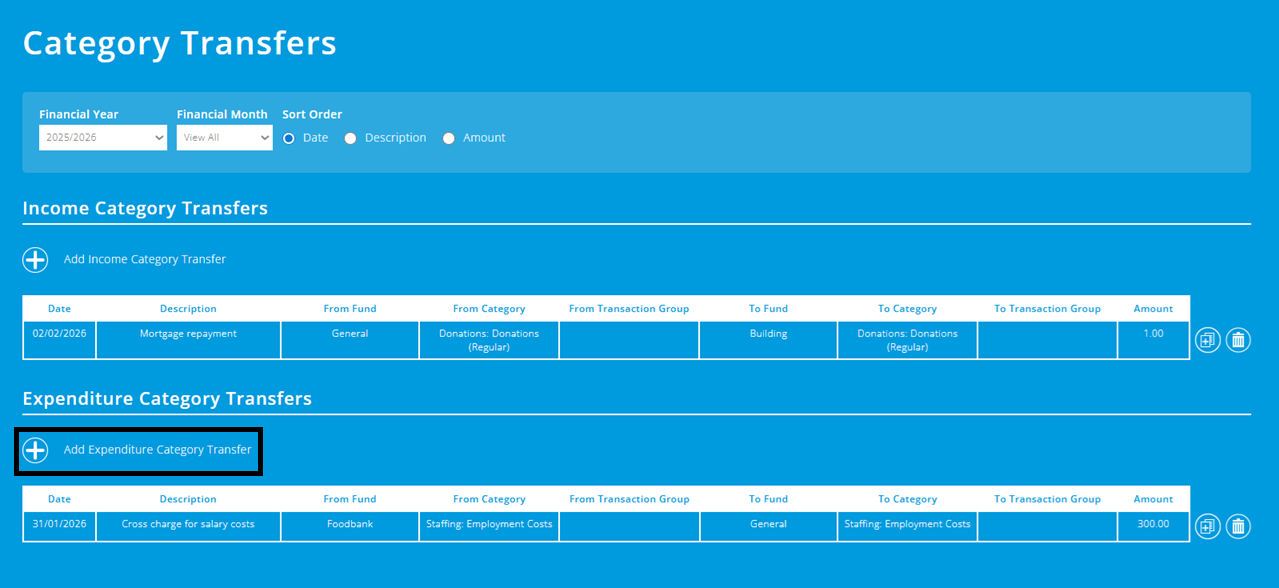
Within the Category Transfers screen, click 'Add Expenditure Category Transfer':
-
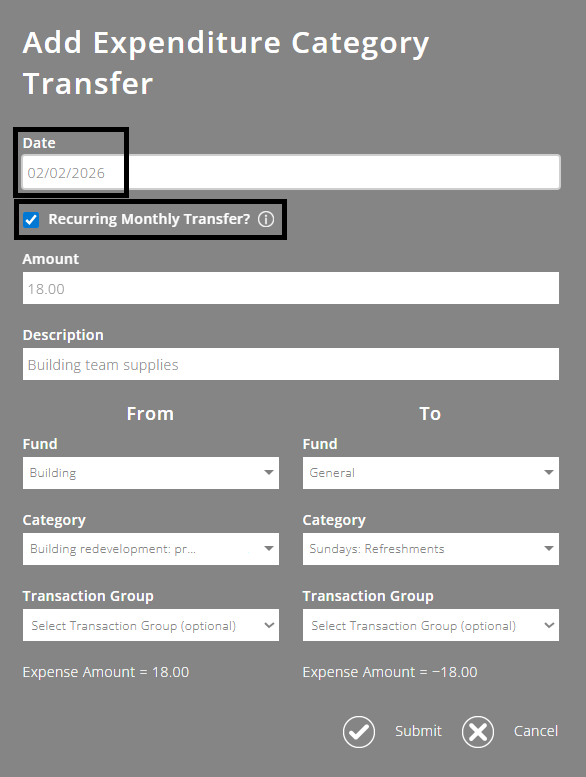
Manually calculate how much expenditure you wish to transfer, and add this figure to the "Amount" box. The system will automatically show this amount as expenditure in one fund and negative expenditure in the other.

- You can see the resulting transfers in the Expenditure Category Transfers section of the Category transfers screen.


If you wish, you can do this incrementally for specific amounts or transactions, or less frequently with greater sums.
Creating a repeating Category Transfer
If you want to set up a repeating category transfer, you can do this when creating the initial category transfer. To do this:
- Add the information as for a single category transfer (described above).
- In the Date box, add the date for the first transfer.
-
Click the checkbox titled 'Recurring Monthly Transfer?' - this will create a transfer on the same day of all subsequent months within the financial year.
To help you better understand the Adjustments module as a whole, please visit the module overview page here.