
Asset & Liability Statement report
This article explains what the Asset & Liability Statement report is, and how it can be used within ExpensePlus.
In this article:
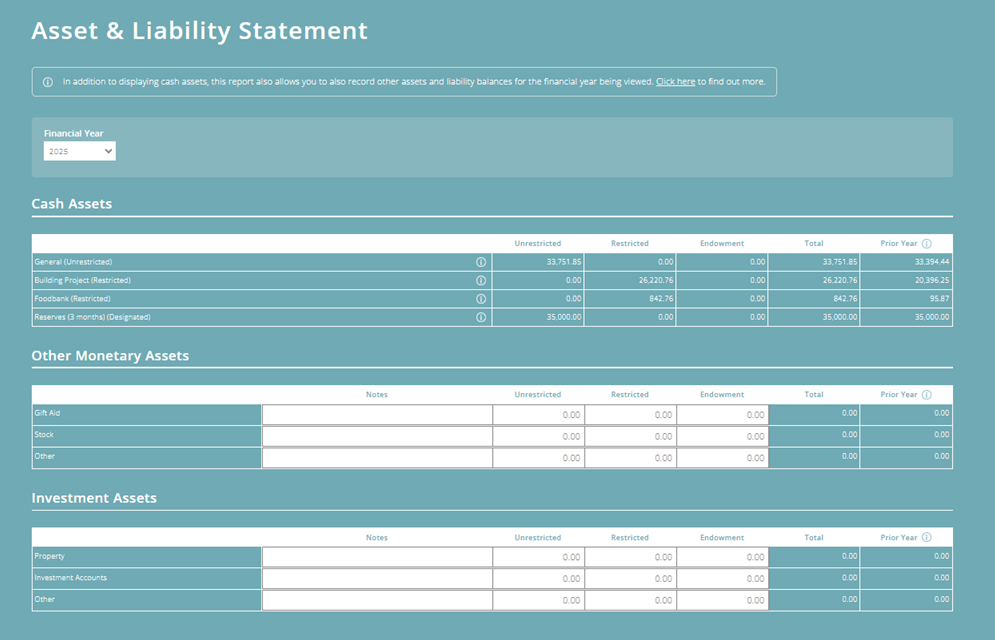
The Asset and Liability Statement report in ExpensePlus enables organisations that create accounts on a receipts and payments basis to:
- keep track of cash assets
- record other assets and liability balances.
This report is only for organisations that create accounts on a receipts and payments basis. If you create accounts on an accruals basis, you will be able to view a balance sheet report instead.
Accessing the Asset & Liability Statement report
You can find this report within the Finance Reports screen of ExpensePlus if:
- the accounting basis for your organisation is set as 'receipts and payments'
- your user role has permission to view this report (or you are a Finance Team user) - find out more about user roles here.

Cash assets
ExpensePlus keeps track of the cash assets of each fund as you add and reconcile transactions.
Example: If the cash asset balance of a fund is £100 and a £50 income transaction is reconciled to that fund, the cash asset balance of that fund will increase to £150.
In order for the cash asset balance of your funds to display correctly, you simply need to:
- Ensure you've set your opening cash asset balances at the start of your first financial year using ExpensePlus.
- Ensure you have uploaded and reconciled transactions correctly within the bank reconciliation module (and added any petty cash transactions if relevant as well).
In Fund Accounting, funds are not the same as bank accounts. If you are unsure what a fund is, check out our blog articles, What is Fund Accounting for Charities? and Fund Accounting for UK Charities: Funds vs Bank Accounts Explained; or check out our Fund Accounting videos page.
Other asset & liability balances
The sections below the cash asset section within the report enable you to record other assets and liability balances. Typically, this would be done at the end of a financial year at the point you are closing your accounts for that year.
Example: If £2,300 of Gift Aid relating to your 2025 financial year doesn't get received into your bank until the next financial year (2026), then you would want to add this (as shown below).
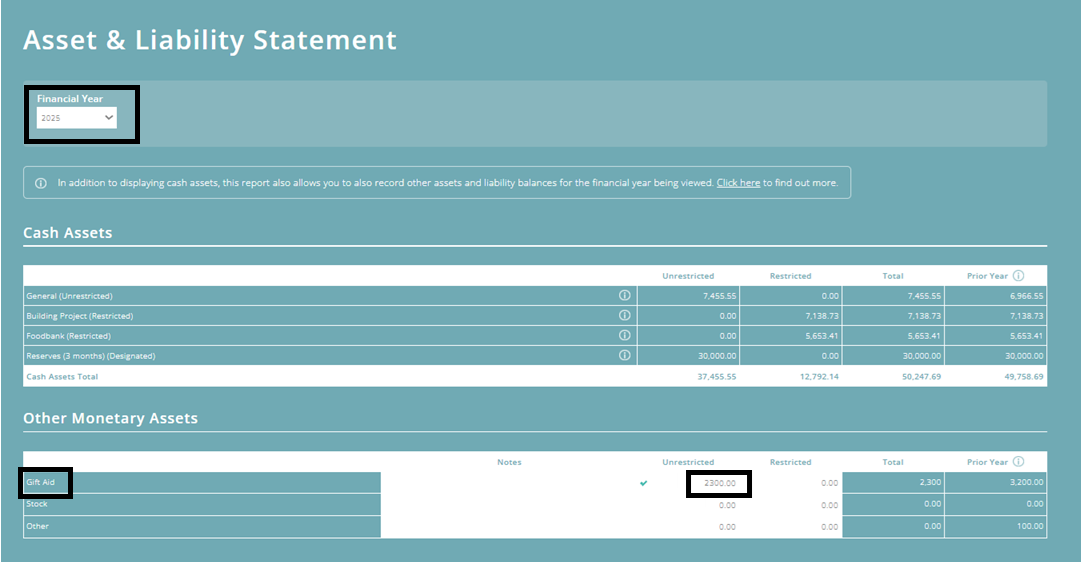
Do ensure you have selected the correct financial year at the top of this report before entering amounts.
The notes fields in the report enable brief notes to be added where helpful (the notes field is optional).
When adding assets or liabilities balances, you only need to include amounts that are of 'material value'. While there isn't a hard and fast rule for what determines whether an amount is of 'material value', for many charities, this would typically include amounts over £500. You can, however, include amounts that are below 'material value', should you deem it appropriate.
This report also displays the totals from the prior year.
If you are viewing your first financial year in ExpensePlus, you can add opening balances within this screen, which will then display in the 'prior year' column of the report.
To better understand the Finance Reports module, please view the module overview video here.